Quantcast

August 2, 2017 (Investigation Update) Multistate Outbreak of Multidrug-Resistant Salmonella Heidelberg Infections Linked to Contact with Dairy Bull Calves

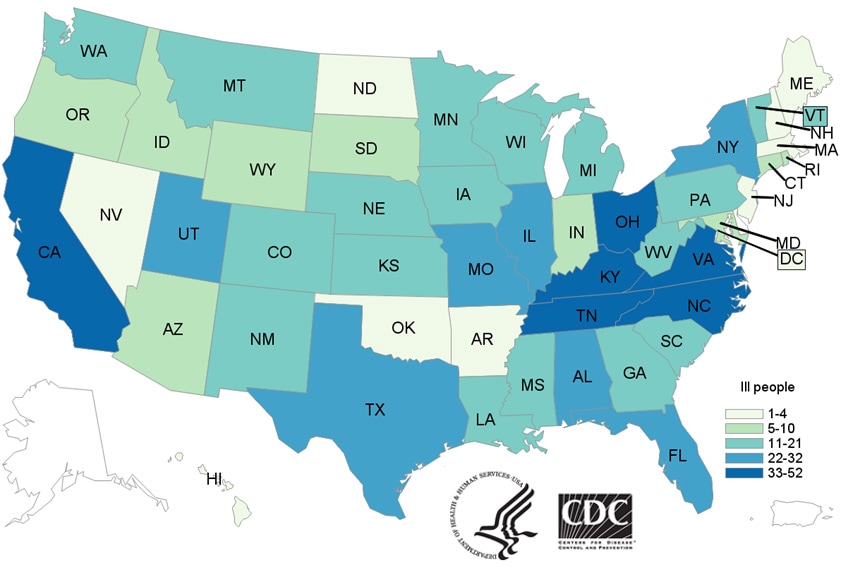
People infected with the outbreak strain of Salmonella Heidelberg, by state of residence, as of July 31, 2017 (n=46)

  • Read the Advice to Calf Handlers and Veterinarians »
  • Read the Information for Health Care Providers »
  • CDC, several states, and the U.S. Department of Agriculture’s Animal and Plant Health Inspection Service (USDA-APHIS) are reopening the investigation of a multistate outbreak of multidrug-resistant Salmonella Heidelberg infections.
  • Ten more people infected with the outbreak strains of Salmonella Heidelberg have been reported since March 20, 2017, when CDC closed the outbreak investigation.
    • Whole genome sequencing on clinical samples from ill people showed a close genetic relationship between the bacteria that sickened people after March 20, 2017, and the bacteria that sickened people before that time. This means that people in both groups were more likely to share a common source of infection and that this outbreak is ongoing.
  • A total of 46 people infected with the outbreak strains of Salmonella Heidelberg have been reported from 14 states.
    • 14 (30%) people have been hospitalized. No deaths have been reported.
    • Illnesses started on dates ranging from January 27, 2015 to July 11, 2017.
    • 15 (33%) people in this outbreak are children under the age of 5.
  • Epidemiologic and laboratory investigations linked ill people in this outbreak to contact with calves, including dairy bull calves. Dairy bull calves are young, male cattle that may be raised for meat.
    • In interviews, ill people answered questions about contact with animals and foods eaten in the week before becoming ill. Of the 44 people interviewed, 29 (66%) reported contact with dairy bull calves or other cattle. Some of the ill people interviewed reported that they became sick after their dairy bull calves became sick or died.
    • Ongoing surveillance in veterinary diagnostic laboratories showed that calves in several states continued to get sick with the outbreak strain of multidrug resistant Salmonella Heidelberg after reports of illnesses in people had stopped. ?
    • Information collected earlier in the outbreak indicated that most of the calves came from Wisconsin. Regulatory officials in several states are now tracing the origin of the calves that are linked to the newer illnesses.
  • Antibiotic-resistance testing conducted by CDC on clinical isolates from ill people shows that the isolates were resistant to multiple types of antibiotics.
    • Antibiotic resistance may be associated with increased risk of hospitalization, development of a bloodstream infection, or treatment failure in patients.
    • Whole genome sequencing has identified multiple antimicrobial resistance genes in outbreak-associated isolates from 33 ill people, 65 cattle, and 11 from animal environments. This correlates with results from standard antibiotic resistance testing methods used by CDC’s National Antimicrobial Resistance Monitoring System (NARMS) laboratory on clinical isolates from eight ill people in this outbreak.
    • The eight isolates tested were susceptible to gentamicin, azithromycin, and meropenem. All eight were resistant to amoxicillin-clavulanic acid, ampicillin, cefoxitin, ceftriaxone, streptomycin, sulfisoxazole, and tetracycline, and had reduced susceptibility to ciprofloxacin. Seven isolates were also resistant to trimethoprim-sulfamethoxazole. Five were also resistant to nalidixic acid. Three were also resistant to chloramphenicol.
  • Follow these steps to prevent illness when working with any livestock:
    • Always wash your hands thoroughly with soap and water right after touching livestock, equipment, or anything in the area where animals live and roam. Use dedicated clothes, shoes, and work gloves when working with livestock. Keep and store these items outside of your home.
    • It is especially important to follow these steps if there are children under age 5 in your household. Young children are more likely to get a Salmonella infection because their immune systems are still developing.
    • Work with your veterinarian to keep your animals healthy and prevent diseases.
  • This investigation is ongoing and we will provide updates as more information becomes available. Livestock owners should continue to watch for increased sicknesses in dairy calves and consult their veterinarian if needed.
July 13, 2017 (Investigation Update) Multistate Outbreaks of Human Salmonella Infections Linked to Live Poultry in Backyard Flocks

/salmonella/live-poultry-06-17/images/big-map-7-7-17.jpg Since the last update on June 1, 2017, 418 more ill people have been reported. The most recent illness began on June 20, 2017. CDC, multiple states, and the U.S. Department of Agriculture…

July 13, 2017 (Investigation Update) Multistate Outbreaks of Human Salmonella Infections Linked to Live Poultry in Backyard Flocks

	People infected with the outbreak strains of Salmonella, by state of residence, as of May 25, 2017 (n=372) /salmonella/live-poultry-06-17/images/big-map-7-7-17.jpg

  • Since the last update on June 1, 2017, 418 more ill people have been reported. The most recent illness began on June 20, 2017.
  • CDC, multiple states, and the U.S. Department of Agriculture’s Animal and Plant Health Inspection Service (USDA-APHIS) are investigating 10 separate multistate outbreaks of Salmonella infections in people who had contact with live poultry in backyard flocks.
    • These outbreaks are caused by several DNA fingerprints of different Salmonella bacteria: Salmonella Braenderup, Salmonella Enteritidis, Salmonella Hadar, Salmonella I 4,[5],12:i-, Salmonella Indiana, Salmonella Infantis, Salmonella Litchfield, Salmonella Mbandaka, Salmonella Muenchen, Salmonella Typhimurium.
  • The outbreak strains of Salmonella have infected a reported 790 people in 48 states and the District of Columbia.
    • Illnesses started on dates ranging from January 4, 2017 to June 20, 2017.
    • 174 ill people have been hospitalized. No deaths have been reported.
  • Epidemiologic, traceback, and laboratory findings link the 10 outbreaks to contact with live poultry, such as chicks and ducklings, from multiple hatcheries.
    • In interviews, 409 (74%) of 553 ill people reported contact with live poultry in the week before illness started.
  • Contact with live poultry or their environment can make people sick with Salmonella infections. Live poultry can be carrying Salmonella bacteria but appear healthy and clean, with no sign of illness.

Sunneen Health Foods Issues Recall of Parfait Due to Undeclared Allergens

Sunneen Health Foods is voluntarily recalling mislabeled Whole Foods Market PB&J parfaits sold at five Whole Foods Market stores in New York and New Jersey because the products contained soy and tree nut (almond and coconut) allergens that were not listed on the product label. People who have an allergy or severe sensitivity to soy or tree nuts run the risk of serious or life-threatening allergic reaction if they consume these products.

Biohealth Nutrition Announces the Recall of Precision Blend Cookies and Cream Product for Undeclared Allergen

Biohealth Nutrition of San Dimas, CA is recalling Precision Blend Cookies & Cream because
product labels failed to declare the food allergen, wheat. People who have an allergy or severe sensitivity to wheat run the risk of a life threatening
allergic reaction, anaphylaxis, that requires immediate medical attention should they consume
products containing allergens.

Coborn’s, Inc. Issues Recall of Incorrectly Labeled Gluten Free Chocolate Chip Bars Due To Undeclared Milk

Coborn’s, Inc. of St. Cloud, Minn. is recalling packages of its Gluten Free Chocolate Chip Bars, some of which were incorrectly labeled as Gluten Free Fudge Brownies. The Gluten Free Fudge Brownie label does not indicate the product contains milk, howe…

Voluntary Recall of CLIF BUILDER’S Bar Chocolate Mint Flavor, CLIF Kid Zbar Protein Chocolate Mint and CLIF Kid Zbar Protein Chocolate Chip Flavors

Clif Bar & Company is initiating a voluntary recall of CLIF® BUILDER’S® Bar Chocolate Mint flavor, and CLIF Kid Zbar® Protein Chocolate Mint and CLIF Kid Zbar® Protein Chocolate Chip flavors due to possible presence of undeclared peanuts and some tree nuts, including almonds, Brazil nuts, cashews, hazelnuts, macadamia nuts, pecans, walnuts and coconuts. Clif Bar & Company is taking this precautionary safety step for people who are allergic to peanuts and these listed tree nuts. People with an allergy to peanuts and these specific tree nuts run the risk of a serious or life-threatening allergic reaction.

Raja Foods Issues Allergy Alert on Undeclared Milk In “Anarkali Peshawari Naan Bread. Upc 0-51179-99605-2. Manufactured July 1st, 2015 Thru July 1st, 2017”

Raja Foods LLC of Skokie, Il is recalling its 15 ounce package of “ANARKALI PESHAWARI NAAN” because they may contain undeclared MILK. People who have allergies to MILK run the risk of serious or life-threatening allergic reaction if they consume these …

Dierbergs Markets Issues Allergy Alert on Undeclared Fish and Milk in Product

St Louis-based Dierbergs is recalling various Deli Products with multiple use by dates in all retail stores because undeclared fish (anchovy) in a Caesar dressing and undeclared milk in 2 Santa Fe wraps. People who have allergies to fish and dairy run …

Global Lamsheng Kee Inc. Issues Allergy Alert on Undeclared Egg in Frozen Fish Tofu, Frozen Fried Fish Ball and Frozen White Fish Ball

Global Lamsheng Kee Inc., Brooklyn, NY is recalling Frozen Fish Tofu, Frozen Fried Fish Ball and Frozen White Fish Ball because they may contain undeclared egg. People who have allergies to egg run the risk of serious or life-threatening allergic react…

Return to Top ▲Return to Top ▲