
Schnucks Bakery has issued a voluntary recall on Devil’s Food Cakes decorated with pecans. Anyone with a pecan allergy who consumed this product may be at risk for serious reaction.
Government Food Alerts
Smith’s Country Cheese, Inc. Voluntarily RECALLS Waxed Gouda Wheels BECAUSE OF POSSIBLE HEALTH RISK
Smith’s Country Cheese of Winchendon, MA is recalling 21 wheels of Waxed Gouda, because it has the potential to be contaminated with Listeria monocytogenes, an organism which can cause serious and sometimes fatal infections in young children, frail or…
La Finquita Emite Una Alerta De Alergias Debido A Una Contaminacion Potencial De Mani O Cacahuate Y Frutos Secos En El Quesito Fresco Campesino
La Finquita, LLC de Stamford, CT está voluntariamente retirando del mercado un lote de Quesito Fresco Campesino o Fresh Farmer’s Cheese como una medida preventiva ya que éstos pueden contener residuos de maní o cacahuate y frutos secos (pistachos). Personas que tengan alergias o sensibilidad severa a estos frutos corren un riesgo serio de una reacción alérgica que puede llegar hacer fatal si se consume dicho producto.
Fish Family Farm, Inc. Issues Allergy Alert On Milk Products And Cream Due To Potential Peanut And Tree Nut Contamination
Fish Family Farm, Inc. of Bolton, CT is voluntarily recalling milk products and cream because as a precautionary measure they may be adulterated with peanut and tree nut (pistachio) allergens. People who have an allergy or severe sensitivity to peanuts or tree nuts (pistachios) run the risk of serious or life-threatening allergic reaction if they consume these products.
La Finquita Cheese Issues An Allergy Alert Due To Potential Peanut And Tree Nut Contamination In Fresh Farmers Cheese
La Finquita, LLC of Stamford, CT is voluntarily recalling one lot of La Finquita Quesito Fresco Campesino Fresh Farmer’s Cheese, as a precautionary measure, because it may be adulterated with peanuts and tree nuts (pistachios). People who have an allergy or severe sensitivity to peanuts or tree nuts (pistachios) run the risk of serious or life-threatening allergic reaction if they consume this product.
June 12, 2014 (Investigation Update) Outbreak of Human Salmonella Cotham and Salmonella Kisarawe Infections Linked to Contact with Pet Bearded Dragons

- As of June 6, 2014, a total of 150 persons infected with the outbreak strains of Salmonella Cotham (145 persons) or Salmonella Kisarawe (5 persons) have been reported from 35 states since February 21, 2012.
- 57% of ill persons are children 5 years of age or younger.
- 43% of ill persons have been hospitalized. No deaths have been reported.
- A second rarely reported serotype, Salmonella Kisarawe, was added to this outbreak investigation after a sample from a bearded dragon collected from an ill person’s home yielded both Salmonella Kisarawe and Salmonella Cotham.
- Epidemiologic, laboratory, and traceback findings have linked this outbreak of Salmonella infections to contact with pet bearded dragons purchased from multiple stores in different states.
- Bearded dragons are popular pet lizards that come in a variety of colors.
- To date, CDC’S NARMS laboratory has conducted antibiotic resistance testing on Salmonella Cotham isolates collected from 12 ill persons infected with the outbreak strain.
- Of the 12 isolates collected from ill persons, one (8%) was resistant to ceftriaxone, an antibiotic used to treat serious Salmonella infections.
- The other 11 (92%) of the 12 isolates collected from ill persons were pansusceptible (susceptible to all antibiotics tested).
- It is very important to wash your hands thoroughly with soap and water right after touching reptiles or anything in the area where they live and roam.
- Simple tips on how to enjoy your pet reptile and protect yourself and your family from illness is available in English and en Español.
June 12, 2014 (Investigation Update) Outbreak of Human Salmonella Cotham and Salmonella Kisarawe Infections Linked to Contact with Pet Bearded Dragons
- As of June 6, 2014, a total of 150 persons infected with the outbreak strains of Salmonella Cotham (145 persons) or Salmonella Kisarawe (5 persons) have been reported from 35 states since February 21, 2012.
- 57% of ill persons are children 5 years of age or younger.
- 43% of ill persons have been hospitalized. No deaths have been reported.
- A second rarely reported serotype, Salmonella Kisarawe, was added to this outbreak investigation after a sample from a bearded dragon collected from an ill person’s home yielded both Salmonella Kisarawe and Salmonella Cotham.
- Epidemiologic, laboratory, and traceback findings have linked this outbreak of Salmonella infections to contact with pet bearded dragons purchased from multiple stores in different states.
- Bearded dragons are popular pet lizards that come in a variety of colors.
- To date, CDC’S NARMS laboratory has conducted antibiotic resistance testing on Salmonella Cotham isolates collected from 12 ill persons infected with the outbreak strain.
- Of the 12 isolates collected from ill persons, one (8%) was resistant to ceftriaxone, an antibiotic used to treat serious Salmonella infections.
- The other 11 (92%) of the 12 isolates collected from ill persons were pansusceptible (susceptible to all antibiotics tested).
- It is very important to wash your hands thoroughly with soap and water right after touching reptiles or anything in the area where they live and roam.
- Simple tips on how to enjoy your pet reptile and protect yourself and your family from illness is available in English and en Español.
Voluntary Product Recall: Wegmans Bagged Ice Due to Possible Metal Fragments – Sold in VA, MD, NJ, and some PA stores only
Wegmans Food Markets, Inc. is voluntarily recalling Wegmans Ice in 18 lb. (UPC 77890 29200) and 7 lb. (UPC 77890 29197) bags sold between January 1 and June 10, 2014.
June 11, 2014 (Investigation Update) Multistate Outbreak of Salmonella Infections Linked to Organic Sprouted Chia Powder
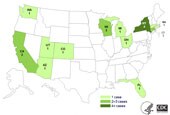
- As of June 9, 2014, a total of 21 persons infected with the outbreak strains of Salmonella Newport (13 persons), Salmonella Hartford (6 persons), or Salmonella Oranienburg (2 persons) have been reported from 12 states.
- Two ill persons have been hospitalized. No deaths have been reported.
- Two ill persons infected with a strain of Salmonella Oranienburg have been identified in two U.S. states.
- Through product testing and interviews with ill people, these illnesses have been combined with the Salmonella Newport and Salmonella Hartford infections previously identified as part of this investigation.
- Collaborative investigation efforts of state, local, and federal public health and regulatory agencies indicate that organic sprouted chia powder is the likely source of this outbreak.
- Chia powder is made from ground dried chia seeds.
- On June 4, 2014, Health Matters America, Inc., recalled products that contain sprouted chia seed powder and sprouted chia/flax seed powder due to possible Salmonella contamination.
- On June 6, 2014, Navitas Naturals expanded their existing recall to include additional expiration dates of products containing organic sprouted chia powder.
- The Public Health Agency of Canada continues to investigate similar cases of Salmonella infection in several Canadian provinces.
- Several Canadian companies have recalled products containing sprouted chia powder or chia seeds.
- CDC recommends that consumers do not eat any of the recalled products products containing chia.
- These products have a long shelf-life and may still be in people’s homes.
- The recalled products were available for purchase in many retail stores nationwide and online.
Princess House, Inc. hace un retiro voluntario de los Platos pequeños Marissa color mandarina debido a niveles de cadmio y plomo
Princess House, Inc., distribuidor nacional por ventas directas de artículos para el hogar y la mesa, anunció hoy que como resultado de pruebas realizadas interna- e independientemente se enteró en fechas muy recientes de que una cantidad mínima de sus platos pequeños Marissa color mandarina, cuando se les usa para ciertos servicios alimenticios, podrían permitir que el cadmio y el plomo en la decoración de los platos se filtren en niveles mayores a los señalados por las directrices de la FDA (la Administración de Alimentos y Medicamentos de los Estados Unidos) y/o por la Proposición 65 del estado de California.
